Journal
Outboard or inboard power for Gulf waters?
By the JJ Marine team ·
For Gulf waters, outboards usually suit smaller, versatile day boats and fishing, while inboards tend to favour larger yachts, longer passages and comfort. The right choice depends on where you cruise, how you use the boat and how you feel about maintenance, fuel burn and resale in the Dubai market.
Why does Gulf boating make this choice different?
The Arabian Gulf is shallow in many areas, with sandbars, reclaimed coastline and man‑made islands. That makes draft and propeller depth more critical than in many European cruising grounds.
Water temperatures are high for much of the year, which can be tough on engines, cooling systems and ancillaries. Strong afternoon sea breezes and short, steep chop are also common, especially outside sheltered areas like Dubai Marina and The Palm.
Local use patterns matter just as much. Many owners split their time between short day trips off Dubai, social cruising to places like World Islands, and longer coastal runs toward Abu Dhabi or the Northern Emirates. Your propulsion choice should reflect how you actually spend your weekends, not a theoretical “perfect” boat.
How do outboards behave in Gulf conditions?
Modern outboards are very well suited to inshore Gulf cruising, fishing and tow‑sports. You can trim them up in shallow water, which helps when exploring lagoons, beach‑club bays and sandbar anchorages that are common along this coast.
On a boat like the Jeanneau Merry Fisher 895, twin 225 hp outboards give an easy 25‑28 knot cruise and roughly high‑30 knot top speed. That is a comfortable envelope for running between Dubai Marina and nearby destinations without pushing the engines hard in the heat.
The ability to lift the lower units clear of the water is useful in warm, salty conditions. It reduces marine growth on gear cases, can mitigate corrosion when the boat lives in the water, and makes it easier to avoid propeller damage when you are not sure of the exact depth under the stern.
When does an inboard make more sense in the Gulf?
Inboards tend to come into their own as overall boat size, weight and range increase. For larger flybridge and motor yachts on regular coastal passages, inboards usually offer a more planted ride and can be better integrated with stabilisers and larger fuel capacities.
Engine room installations also isolate noise and vibration from the saloon and cabins. For owners who focus on overnighting and longer cruises rather than quick day trips, that refinement can matter more than shallow‑water ability.
For many inboard yachts in the Dubai market, systems like generators, air‑conditioning chillers and watermakers are all centred around the engine room. This can simplify service access compared to multiple separate compartments on a smaller outboard boat.
What are the key performance differences?
Outboards on a hull designed for them typically offer strong hole‑shot and responsive trim, which suits water sports and agile coastal driving. With a lighter engine package hung on the transom, smaller boats can be easier to balance and keep on plane at lower speeds.
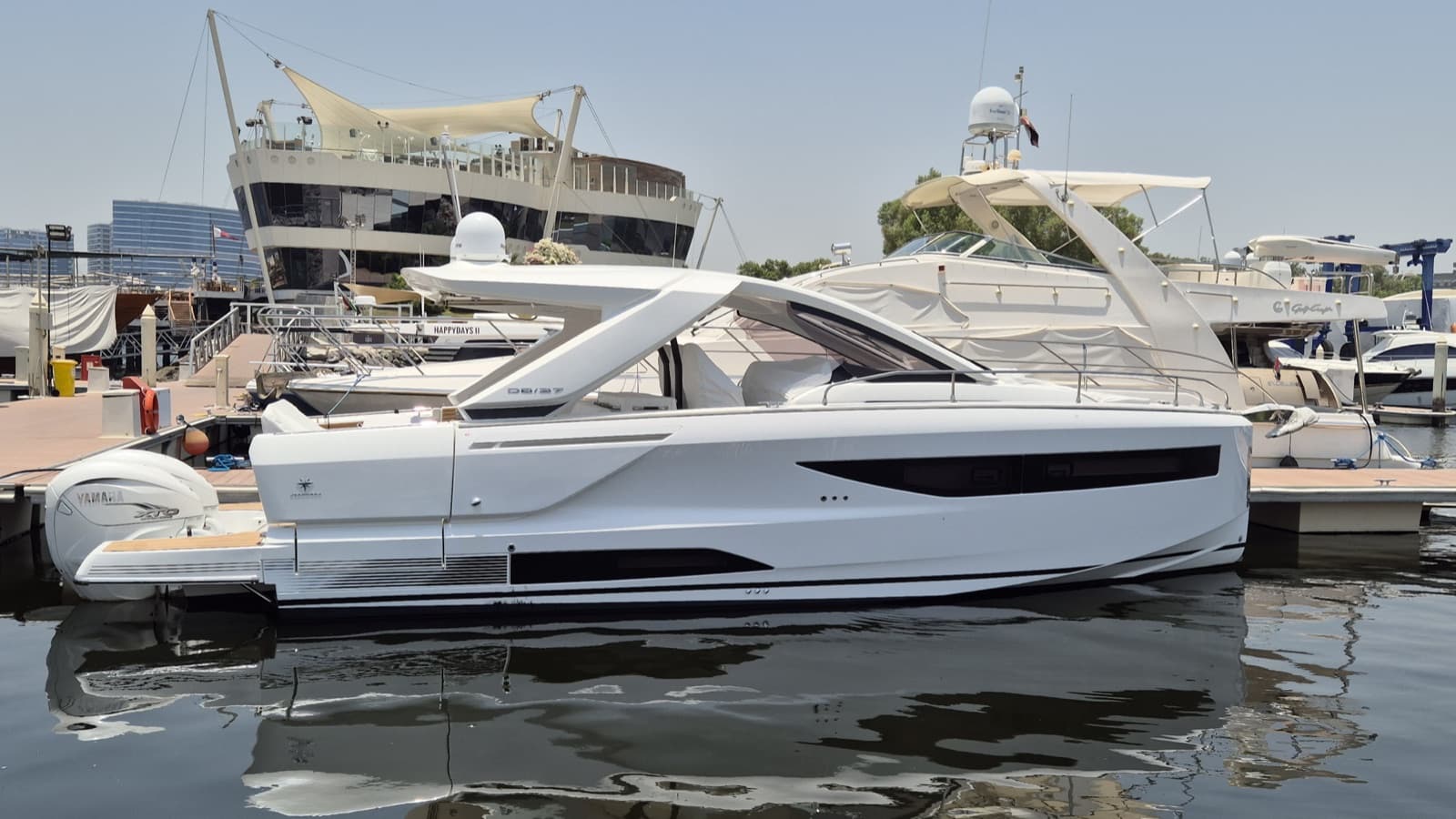
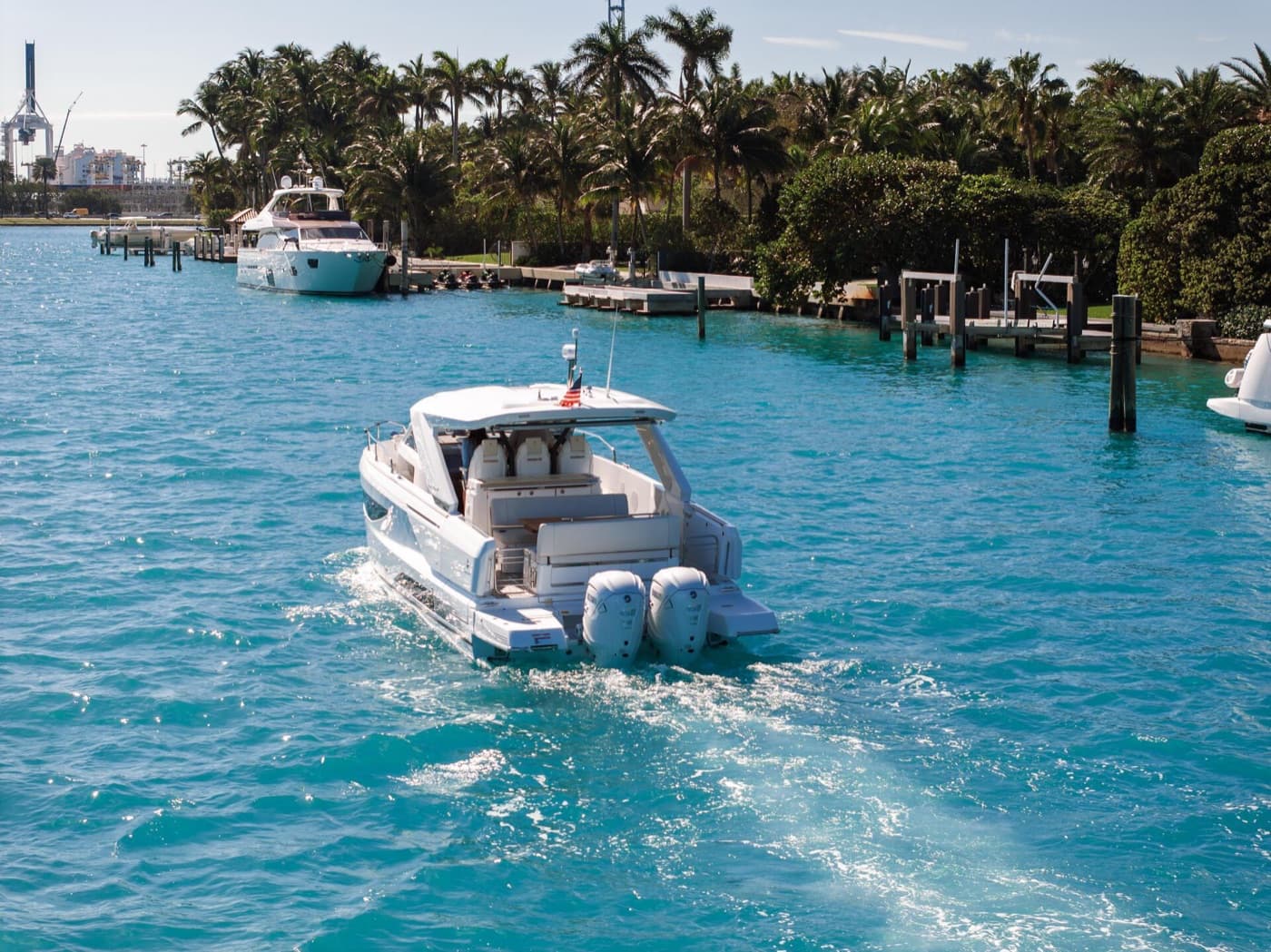
The Jeanneau DB/37 OB illustrates this well. With twin outboards up to 900 hp, it runs comfortably around 25‑30 knots and can reach 40‑45 knots when conditions allow. That kind of performance is attractive if you like to run early or late, making use of the cooler parts of the day.
Inboards often focus on efficient cruising at a steady speed rather than sprinting. On heavier planing or semi‑displacement hulls, they can feel smoother in a head sea, with the weight of the engines lower and further forward in the boat. For longer legs in open water, this can be reassuring.
How do draft and access to shallow areas compare?
Draft is one of the clearest practical differences in Gulf waters. Outboards allow you to raise the legs when creeping into a shallow anchorage or loading guests close to the beach. This suits areas with sandbars and gently shelving coastlines.
Inboard propellers and shafts sit deeper and cannot be trimmed. On a larger yacht, that is the price you pay for a more substantial running surface and offshore poise. It is rarely a problem in marked channels and marinas, but it can limit how boldly you explore unmarked shallows.
For many Dubai owners, a good rule of thumb is straightforward. If your boating is mostly short day trips, swimming at sandbars and visiting waterside restaurants, outboards are often more practical. If you expect to spend more time offshore or on extended coastal hops, inboards begin to show their strengths.
What about maintenance, reliability and ownership costs?
In the Gulf climate, both systems work well when correctly specified, serviced and cooled. Outboards are easier to access for routine tasks like anode changes and basic servicing, and many owners appreciate being able to see the entire engine installation from the cockpit.
Inboards concentrate more systems in the engine room. That can be efficient for professional crews and service teams, but less convenient if you like to do jobs yourself. Access quality varies a lot by model, so it pays to inspect real boats carefully.
For a high‑level comparison of typical ownership considerations:
| Factor | Outboard engines | Inboard engines | |--------------------------------|-----------------------------------------------|---------------------------------------------------| | Typical boat size in Dubai | Smaller to mid‑size day boats and fishers | Larger sports cruisers and motor yachts | | Shallow water flexibility | Very good - legs trim up | Limited - fixed shafts / drives | | Noise and vibration underway | More present in cockpit | Often lower in cabins and saloon | | Engine access | Excellent from cockpit or swim platform | Depends on engine room layout | |Typical user involvement | Suits hands‑on owners | Often suits crewed or professionally managed use | |Resale focus in local market | Strong for trailerable and marina‑based boats | Strong for larger berthing‑based yachts |
For a deeper dive into running costs and their impact on your budget, it helps to look at the broader picture of ownership. Guides such as /guides/how-much-does-a-yacht-cost-in-dubai and /guides/cost-of-owning-a-yacht-in-dubai are useful starting points.
How should a first‑time buyer decide for Gulf use?
Start with how you actually plan to use the boat for the next three to five years, not a distant dream itinerary. List your most likely trips, how many people you usually host and whether you prefer to helm yourself or rely on a skipper.
If your priority is flexible day boating from Dubai Marina with easy maintenance and access to shallow bays, an outboard‑powered boat such as the Jeanneau Merry Fisher 895 or Jeanneau DB/37 OB can make a lot of sense. They deliver strong performance, simple access to the engines and layouts tailored to day‑into‑weekend use.
If you see yourself stepping up into a larger yacht for extended cruising, crewed operation and more time spent at anchor in comfort, focusing on inboard‑powered options is usually wiser. The buying process will also involve decisions about berthing, which we explore in the /guides/dubai-marina-berthing-guide and in our advice on /guides/what-size-yacht-do-you-need.
It is perfectly reasonable to treat your first outboard boat as a stepping stone. Our guide to /guides/new-vs-pre-owned-yachts-dubai can help you decide whether to start with a pre‑owned model to refine your preferences before committing to a larger inboard yacht.
Can you mix uses - day boat now, charter later?
Many Dubai owners want a boat that suits private family use now but might enter light charter in the future. Outboard‑powered day boats can work in this role for shorter, informal trips, particularly if you focus on comfort features and easy boarding.
For more structured charter operations, inboard‑powered yachts often fit better, with multiple guest cabins, crew areas and more defined service spaces. In either case, planning propulsion with future use in mind will make later upgrades or resale simpler.
If you are considering charter income, take time to understand how charter guests use propulsion in practice. They care more about comfort, reliability and noise levels than whether the power comes from outboards or inboards. Layout and service quality will shape their experience more than engine choice.
JJ Marine is the official Jeanneau dealer in Dubai, based at Vida Dubai Marina & Yacht Club, with four decades on the water helping owners choose the right boats for Gulf conditions. Whether you lean toward a versatile outboard day boat or a larger inboard yacht, our team can walk you through real options, arrange viewings and organise charter trials. You can call or WhatsApp us on +971 50 454 8415, or email jaamaa@jjmarine.ae, and we will help you decide what truly fits your life on the water.