Journal
The sea trial checklist: what to test before you buy
By the JJ Marine team ·
A good sea trial confirms far more than top speed. It shows how a yacht starts from cold, handles at low speed, runs at cruise and feels at rest, while giving you time to test every system on board. With a clear checklist and a calm, methodical approach, you can leave the water knowing whether to proceed, renegotiate or walk away.
What is a sea trial and why does it matter when buying a yacht?
A sea trial is simply a test run of the yacht on the water under normal operating conditions. It usually comes after your initial viewing and before you commit to purchase.
For buyers in Dubai, it is your chance to see how a boat behaves in real sea conditions, not just at the dock in Dubai Marina. Alongside a professional survey, it is one of the most important steps when buying your first yacht in Dubai.
How should you prepare for a sea trial?
Agree the basic conditions in writing: duration, fuel level, number of people on board and the expected sea state. As a rule, you want enough time for the engines to reach full operating temperature and to test multiple speeds and manoeuvres.
Ask the seller or broker for recent service records and any known defects in advance. Bring a notepad or notes app, your phone for photos and video, and, if you are serious about the boat, consider having your surveyor attend.
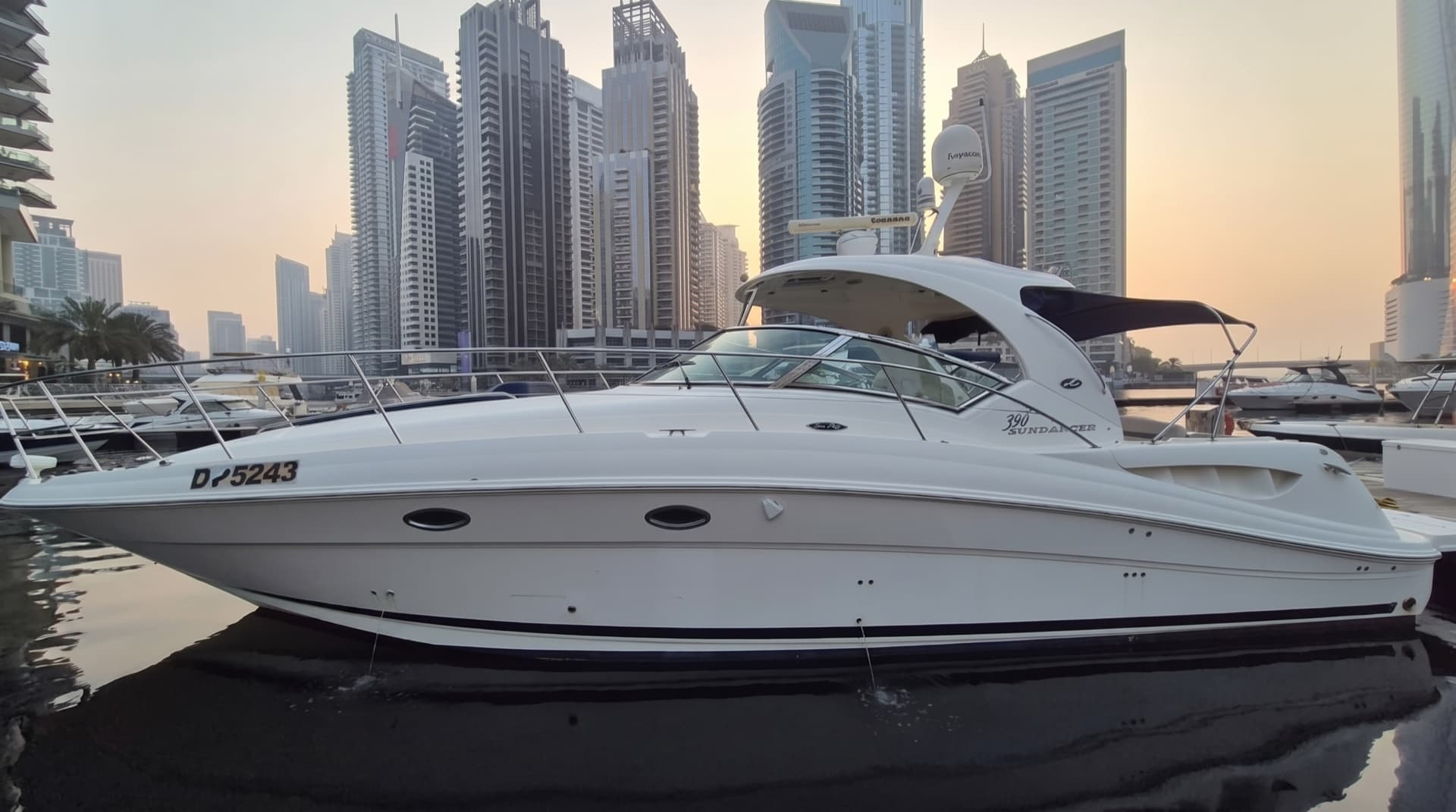
If you are looking at a specific pre-owned yacht, such as a Sea Ray 390 Sundancer based in Dubai Marina, study the specification sheet beforehand. Knowing that it has twin MerCruiser V-drives, a generator, three-zone air conditioning and a bow thruster helps you plan what you want to test.
What should you check before leaving the dock?
Start your sea trial checklist before the lines are even off. Walk the exterior slowly, checking the hull sides, deck fittings, windscreens and rails for obvious damage, cracks or loose hardware.
Open the engine hatch and inspect the machinery space. You are looking for leaks, corrosion, fuel or oil smells and general cleanliness. On a petrol-powered cruiser like the Sea Ray 390 Sundancer, insist on proper ventilation and a sniff test before starting.
Then run through key pre-departure items:
- Shore power disconnected and stowed
- Sea cocks open where required
- Bilge levels normal, bilge pumps operational
- Navigation lights, horn and wipers tested
- Plotter, depth sounder and VHF powered up
Note how easily the boat moves from cold start to ready-to-go. Long delays, stubborn engines or a confusing start-up routine are all useful information.
How do you evaluate engine performance and sound levels?
Engines should start cleanly from cold with minimal smoke and no harsh knocking. Some light vapour on initial start can be normal, especially on older engines, but persistent smoke or strong smells are a warning sign.
Once clear of the marina, bring the boat gently on plane while watching engine instruments. Check:
- Oil pressure rises and then stabilises in the normal range
- Coolant temperature rises and then holds steady
- Charging voltage is healthy on all banks
Run the yacht at several steady rpm settings, including the typical cruise band and a short run towards maximum throttle, conditions allowing. Listen for vibration, rattles or resonances. A well set up boat should feel smoother at her natural cruise speed than at awkward mid-range rpm.
On a planing cruiser that typically cruises at around 22 - 24 knots, such as the 12.50 m Sea Ray 390 Sundancer, you are looking for a clean transition onto the plane without struggling or excessive bow rise. Heavy labouring, poor acceleration or uneven rpm between engines may indicate propeller, engine or hull issues.
How should you test handling at low speed and in close quarters?
Most buyers focus on high-speed performance, yet low-speed handling is what you live with every time you enter Dubai Marina. Before heading offshore, take a few minutes in open water to feel how the yacht responds in and out of gear.
Practise:
- Straight-line tracking at idle
- Slow turns both directions
- Controlled stops from slow ahead to neutral and reverse
If the boat has a bow thruster, test it meaningfully, not just a quick tap. Hold it to port and starboard for a few seconds, checking for strong response and unusual noises. On a mid-cabin cruiser with V-drives and a thruster, you should be able to ease the bow accurately towards an imaginary berth without drama.
Back at the berth at the end of the trial, ask to dock yourself if you are comfortable, or watch the skipper closely. A boat that feels predictable and docile at low speed will be far more enjoyable to own.
What ride and comfort checks should you make at sea?
Try to conduct the sea trial in representative conditions, not flat calm if you normally cruise on choppier days. You are assessing how the hull slices, lands and keeps the interior liveable.
At planing speed, look for solid, confident progress through small waves without slamming or spray reaching the windscreen unnecessarily. Inside, pay attention to doors, lockers and cabin soles for creaks or rattles.
Then slow to displacement or semi-displacement speeds. Some boats wallow uncomfortably or roll heavily in beam seas. If you plan to anchor off the Palm or in quieter coves, how the yacht behaves at 5 - 7 knots or at rest will matter as much as fast performance.
What interior systems should you test on board?
A sea trial is the ideal time to test systems under realistic load. On a cruiser with generator and air conditioning, run the generator for most of the trial and switch on multiple air conditioning zones, such as the three zones aboard the Sea Ray 390 Sundancer.
Work through a simple systems checklist:
- 12V and 230V panels and breakers
- Generator start/stop, load carrying and noise
- Air conditioning cooling and airflow in each cabin and cockpit
- Fresh water pump, taps, shower, heads and holding tank operation
- Galley appliances and lighting in all areas
If you are considering overnighting or weekend trips, lie on the berths, sit at the dinette and stand in the shower. Practical comfort is as important as aesthetics, especially when you start thinking seriously about the cost of owning a yacht in Dubai.
How do you check electronics and navigation equipment?
Modern yachts rely heavily on electronics, and replacement can be expensive. Power up the full navigation suite and leave it running throughout the trial.
Check that the chartplotter locks onto GPS, the depth sounder reads consistently and the radar, if fitted, transmits and displays targets correctly. On a boat with a Raymarine package and radar, zoom in and out, set waypoints and change display modes so you know the system is functioning properly.
If there is an autopilot, test it in open water at different speeds, ensuring it holds course without constant correction. A sea trial is also the right moment to check entertainment systems, Wi-Fi and any onboard cameras, especially if you intend to charter the boat or fit her into a busy Dubai Marina berthing routine.
What should you inspect immediately after the trial?
When the engines are shut down, return to the engine space. Look for any fresh drips, weeps or spray from hoses, shaft seals or fuel lines. Hot surfaces will make small leaks easier to spot.
Check:
- Bilge water level and any new fluid
- Engine mounts and couplings for movement
- Exhaust runs for leaks or excessive heat
Walk the interior again and notice any smells that were not present before you left the dock, such as fumes or hot electrics. This is also a good time to ask the skipper or broker about any odd noises or readings you noticed during the run.
How do you use sea trial results in your buying decision?
Combine your sea trial notes with the survey report, service history and your running-cost estimates. If issues emerged, do not ignore them. Decide whether they are routine maintenance items, negotiation points or reasons to move on to another boat.
In Dubai, buyers often compare the sea trial experience of several pre-owned yachts before deciding whether to stretch to a new build. A well conducted trial can save you from ongoing headaches or, equally, give you the confidence to proceed with a boat that feels right on the water.
If you are still refining your brief, it can help to tie sea trial impressions back to basics such as what size yacht you actually need and how you plan to use her. Our guide to what size yacht you need is a useful companion when you are weighing up different layouts and performance profiles.
JJ Marine has spent four decades on the water helping Dubai buyers move from first viewing to confident ownership. Whether you are sea trialling a specific model in Dubai Marina or weighing up shortlists of new and pre-owned yachts, we can guide you through each step. Speak to the team at Vida Dubai Marina & Yacht Club on WhatsApp or phone at +971 50 454 8415, or email jaamaa@jjmarine.ae to discuss your next trial.