Journal
How far can you realistically cruise from Dubai on a tank of fuel (or water) with different yacht types?
By the JJ Marine team ·
From Dubai, a typical 35 to 40 foot planing powerboat can realistically cruise 120 to 180 nautical miles on a tank in calm Gulf conditions, while an efficient inboard cruiser may reach 200 to 250 nautical miles. A comparable sailing yacht, using its engine sparingly, can plan for 400 to 600 nautical miles with a blend of sail and fuel, limited more by water and comfort than diesel.
What distances are realistic from Dubai on one tank?
In the Gulf, range is shaped by fuel capacity, hull type, speed and sea state. Heat, headwinds and running the generator all add to consumption, so paper range figures rarely match reality.
From Dubai, many private owners think in terms of “comfortable return range” rather than the furthest theoretical distance. That usually means out and back legs in the 60 to 120 nautical mile total band, with at least a 30 to 40 percent fuel reserve.
Typical real‑world ranges from Dubai
These are broad, practice‑based bands for well‑maintained boats in settled conditions:
| Yacht type (approx. 35‑40 ft) | Typical cruise speed | Sensible one‑way leg* | Comfortable return range (out + back) | |----------------------------------------|----------------------|------------------------|----------------------------------------| | Fast outboard weekender (planing) | 20‑25 knots | 60‑90 nm | 80‑120 nm | | Inboard cruiser (diesel, planing/semi) | 18‑22 knots | 80‑120 nm | 100‑160 nm | | Sailing yacht (using engine lightly) | 6‑7 knots under power| 150‑250 nm under power | 400‑600 nm with sail + fuel |
*Assuming at least 30 % fuel in reserve on arrival.
From Dubai Marina, that gives you relaxed reach to Abu Dhabi, Sir Bani Yas, Ras Al Khaimah and Khasab on one tank in the right boat, with scope to extend much further if you sail.
How far could specific Jeanneau models go from Dubai?
Using the real capacities of three Jeanneau models, we can outline conservative planning numbers. Actual range will still depend on loading, sea state and how carefully you trim and helm the boat.
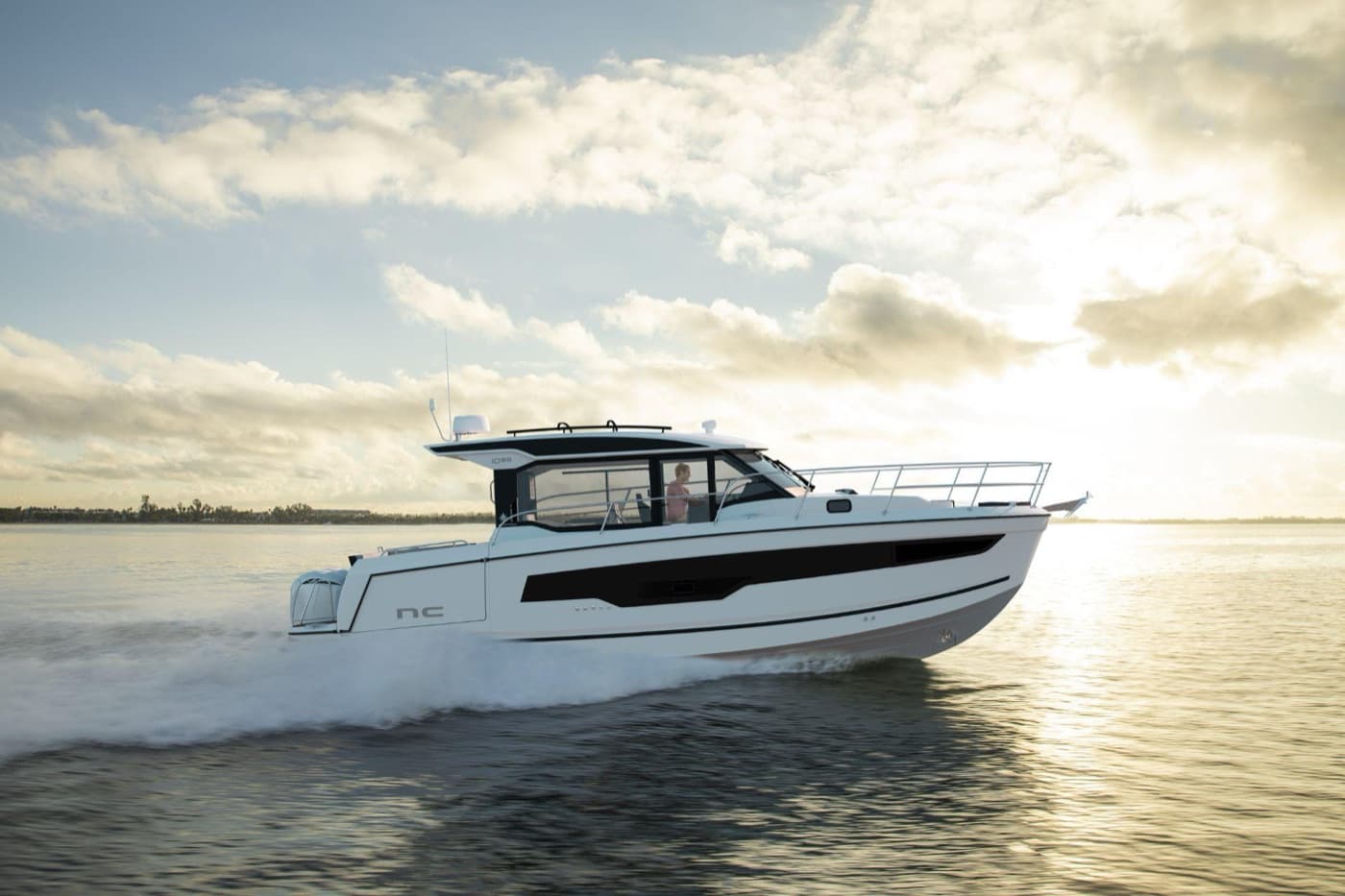
Merry Fisher 1095 Coupe Series 2 – outboard family cruiser
The Merry Fisher 1095 Coupe Series 2 is 10.45 m with twin Yamaha V6 300 hp outboards and a 740 L fuel tank, carrying 160 L of fresh water. As a planing weekender, it is optimised for family cruising at moderate to brisk speeds.
For modern twin 300 hp outboards at a sensible cruise of around 20 knots, many owners in similar boats find that planning around 1.0 to 1.3 nautical miles per litre is realistic in calm water. Using a mid‑point of roughly 1.15 nm/L, 740 L gives a theoretical still‑water range of about 850 nm.
In Gulf reality, you would sensibly cut that figure down. With heat, possible chop, some generator time and a 30 to 40 percent reserve, many owners would plan coastal legs of 70 to 100 nm each way. That comfortably covers Dubai to Abu Dhabi, Dubai to Sir Bani Yas with a refuel stop, or Dubai to Khasab with margin in hand.
Water is more limiting than fuel for long weekends. With 160 L on board, a conservative 20 L per person per day for a family of four yields two days without rationing, three if you are disciplined. A compact watermaker starts to look attractive if you routinely stay out for longer.
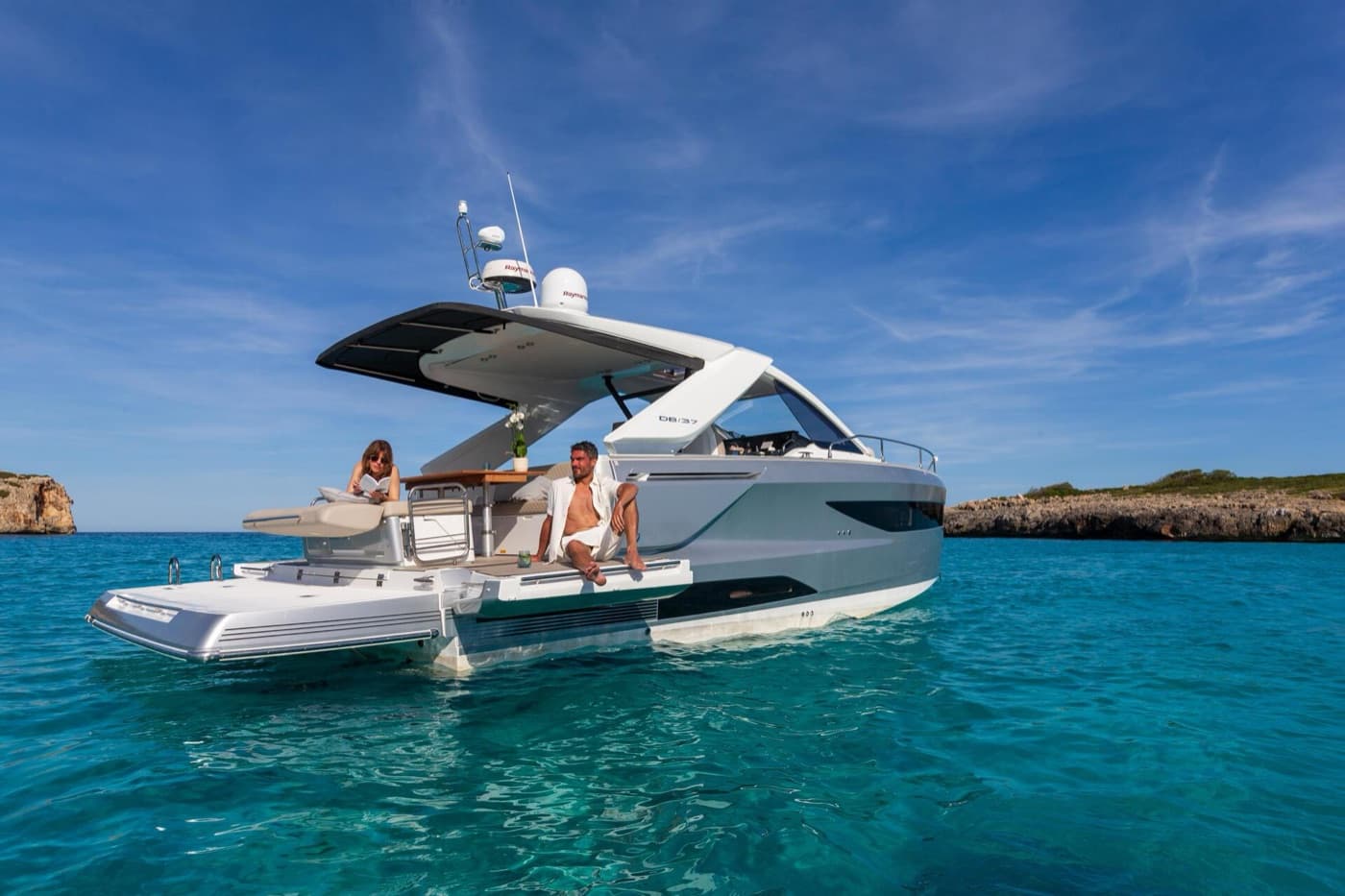
DB/37 IB – inboard diesel cruiser for longer passages
The Jeanneau DB/37 IB is an 11.84 m inboard cruiser with twin 320 hp Volvo D4 diesels, 960 L of fuel and 250 L of water. Inboard diesels tend to be more economical per mile than petrol outboards at displacement to semi‑planing speeds.
An efficient setup of this type at 18 to 22 knots might reasonably be planned around 1.4 to 1.7 nm/L in good conditions. Using the middle of that range for planning, 960 L allows a still‑water range of around 1,500 nm on paper.
In practice, for a Dubai‑based owner, that translates into very comfortable return trips of 120 to 160 nm with a reserve. That easily takes you from Dubai to Doha or Bahrain as staged coastal hops with fuel at intermediate ports, if paperwork and weather align.
With 250 L of fresh water, a couple cruising thoughtfully can manage three to four days without hardship. For extended Gulf passages on a DB/37 IB, most owners would either add a watermaker, be disciplined about showers, or integrate regular marina stops into their cruising plan.
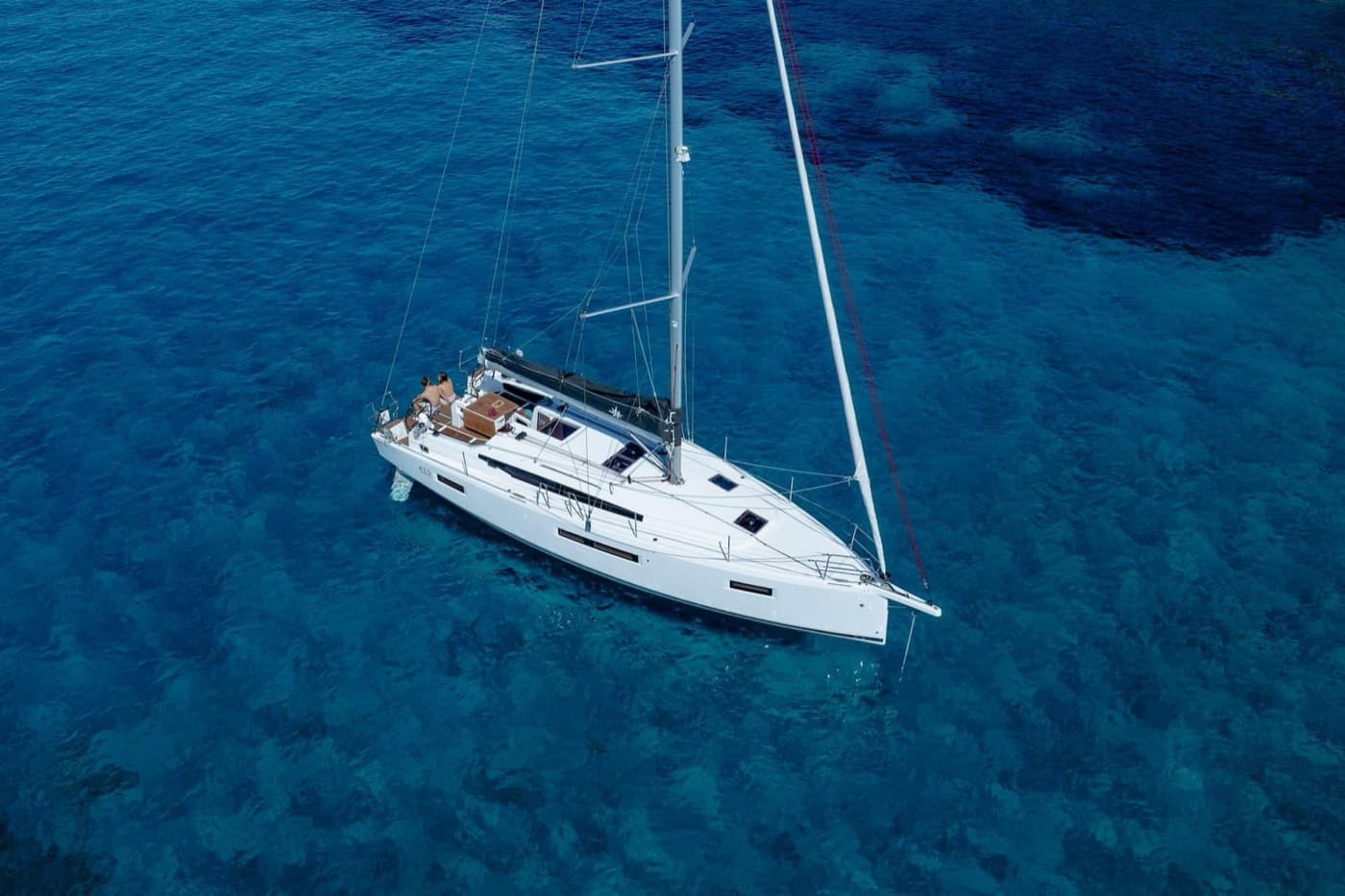
Sun Odyssey 415 – how does a sailing yacht change the picture?
The Sun Odyssey 415 is a 12.35 m sailing yacht with a 200 L diesel tank, 330 L of water and a 45 hp Yanmar. Under power alone, at around 6 to 7 knots, you might plan on 2 to 3 litres per nautical mile as a cautious working number in cruising trim.
That gives you a powered range of roughly 65 to 100 nm on a half tank, keeping the other half as reserve. The real advantage is that once you are sailing, the tank becomes a comfort buffer rather than your only source of movement.
A Dubai‑based cruiser in a Sun Odyssey 415 might plan Gulf passages of 400 to 600 nm using a blend of sailing and careful motoring, especially at night or in calms. Here, 330 L of water becomes the primary constraint, not fuel, unless you have a watermaker or plan regular marina stops.
For context on whether a yacht like the Sun Odyssey 415 is the right step for you, it is worth reading up on buying your first yacht in Dubai and how to think about what size yacht you need.
What real‑world factors reduce your range from Dubai?
Even with the same hull and engines, no two days are identical. Gulf conditions can erode your range steadily if you do not adjust.
Headwinds and sea state are the biggest variables. A short, steep chop between Dubai and Abu Dhabi, or pushing into the prevailing wind up the coast, will raise your fuel burn noticeably if you insist on holding the same speed.
Weight and trim matter. Full tanks, toys, tenders, dive gear and extra guests all increase drag. A well‑trimmed boat with a clean hull and propellers can feel like a different vessel compared with a fouled bottom and a locker full of unused kit.
Hotel loads also quietly eat into range. Air conditioning, gyro stabilisers and generators all require power, which increases engine load if you are not plugged into shore power. On smaller weekenders, this can change a comfortable margin into something tighter than you would like.
How do you plan fuel and water for typical Gulf passages?
Planning from Dubai usually starts with plotting safe legs between marinas with reliable fuel and clear approaches. You then work backwards from your realistic fuel consumption, not the most flattering brochure number.
As a rule, owners cruising the Gulf in planing powerboats will often:
- Base range on their own logbook consumption over several trips, not a single “good day”.
- Plan to arrive with at least 30 percent fuel remaining, more if forecast conditions are marginal.
- Adjust speed to conditions instead of trying to “hold a schedule” at all costs.
For water, think in daily usage rather than tank size. Without a watermaker, many crews use 15 to 25 L per person per day when being careful but comfortable. With a watermaker on board, fuel often becomes the only hard limit between ports, especially on sailing yachts.
If you are new to planning your own passages, looking at both the cost of owning a yacht in Dubai and how much a yacht costs in Dubai can help you decide where to invest: extra tankage, a watermaker, or a different hull type.
Which yacht types suit longer‑range Gulf cruising from Dubai?
There is no single “right” answer. It depends on how far you want to go, how quickly, and how often you accept marina stops.
Fast outboard weekenders such as the Merry Fisher 1095 Coupe Series 2 are ideal for Dubai‑centric day use and short coastal hops at higher speeds, with enough fuel for conservative overnight trips. Inboard diesel cruisers like the DB/37 IB stretch that radius comfortably, reduce fuel cost per mile and offer quieter, more stable longer runs.
Sailing yachts such as the Sun Odyssey 415 trade speed for range and independence. With thoughtful water management, they are well‑suited to extended passages where you are happy at 6 to 7 knots and less reliant on fuel docks.
If you are trying to decide between a new or pre‑owned yacht for this kind of cruising, it is worth comparing layouts, tankage and running costs carefully. Our guide on new vs pre‑owned yachts in Dubai is a useful starting point.
JJ Marine is the official Jeanneau dealer in Dubai, based at Vida Dubai Marina & Yacht Club, with four decades on the water across yacht sales, charter and management. If you would like to talk through realistic range for specific Jeanneau models, or arrange a viewing or charter trial from Dubai Marina, you can reach the team on WhatsApp or phone at +971 50 454 8415, or email jaamaa@jjmarine.ae.
Frequently asked questions
How much fuel should I keep in reserve when cruising from Dubai?
For Gulf coastal cruising from Dubai, many skippers plan to arrive with at least 30 percent of fuel remaining, and more if conditions or timing are uncertain. This allows for detours around weather or traffic separation zones, unexpected headwinds, and extra time manoeuvring in marinas.
Is fuel or water usually the limiting factor on a Dubai cruise?
On most powerboats in the 30 to 40 foot range, fuel is the primary limitation, as water tanks are sized for weekend stays and marinas are frequent. On sailing yachts, especially those with modest engines, water can become the main constraint unless you install a watermaker or plan regular marina calls.
Can I cruise from Dubai to Oman on one tank of fuel?
In a well‑found 35 to 40 foot inboard diesel cruiser with generous tankage and conservative planning, Dubai to the Musandam area can be within a comfortable one‑tank range in fair conditions. However, you should always plan with reserves, confirm fuel availability at your destination, and ensure that customs, immigration and permissions are handled in advance.
How can I improve the range of my existing yacht in the Gulf?
You can improve range by cleaning the hull and propellers regularly, trimming the boat correctly, reducing unnecessary weight on board and moderating cruising speed. Servicing engines to keep them in tune, managing hotel loads such as air conditioning, and planning passages around favourable tides and forecasts will also make a noticeable difference.